The “War of Currents”
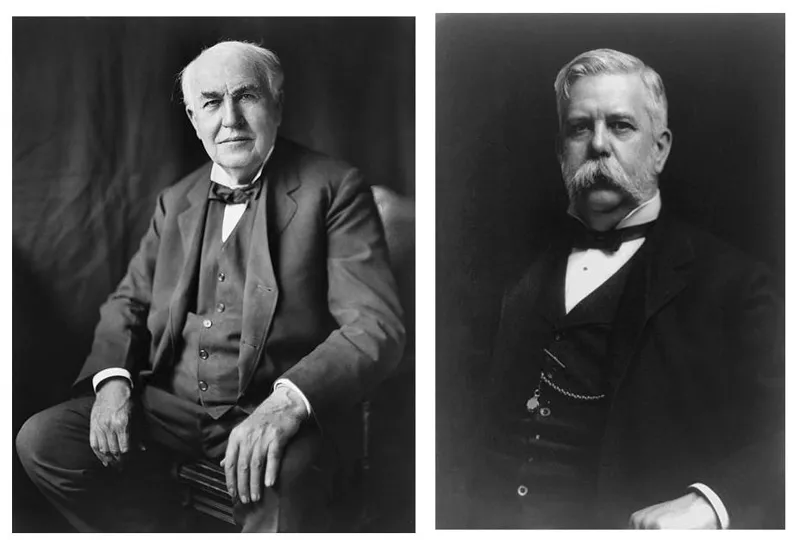
[1] The "War of Currents" was a major event in the history of electricity. In the late 19th century, two different systems were being developed to use electricity for lighting and powering machinery. One was called direct current (DC). The other was called alternating current (AC).
[2] Thomas Edison was a famous inventor and businessman. He believed DC was the best way to power homes and businesses. He set up a DC power plant in New York City in 1882. He argued that it was safer and more reliable than AC, which he said was unpredictable and dangerous.
[3] George Westinghouse was an industrialist1. He saw the potential of AC and bought an AC system from Nikola Tesla. Tesla's system used a transformer to change the voltage of the electricity. The transformer made it possible to send electricity over long distances with less loss of power than with DC. Westinghouse saw that AC was less wasteful and less expensive than DC. He saw its potential for powering the world.
[4] The "War of Currents" began when Edison started to argue against AC. He used fear and misinformation to try to discredit it. He even electrocuted animals with AC in public to try to convince people that it was dangerous. He also tried to persuade the government to pass laws to require the use of DC electricity. However, this was not successful.
[5] Westinghouse and Tesla fought back. They showed the safety and efficiency of AC through public demonstrations. They won the contract to power the Chicago World's Fair in 1893. This made a big difference in the "War of Currents". It demonstrated the reliability and effectiveness of AC to the world.
[6] In the end, Westinghouse's AC system won. It became the main system for the transmission of electricity. Most electrical systems around the world use AC today. DC is mainly used in batteries and some electronic devices.
[7] The "War of Currents" had a big effect on the world of electricity. It showed how competition and innovation2 drive progress and how public opinion and government laws affect technological change. It also showed the power of science in solving practical problems and improving people's lives.
[8] Edison lost the "War of Currents", but his inventions (such as the light bulb and phonograph) shaped the modern world in many ways. Similarly, the work of both Tesla and Westinghouse has had a large effect on the world. Together, these people helped to make the modern age of electricity.
1An industrialist is someone who owns or has an important position in a large industrial company.
2Innovation means the invention of new ideas, methods, and equipment, etc.

Bình luận