READ
PREVIEW
- What do you think will happen next?
- How do you think the story will end?
VOCABULARY TO KNOW BEFORE YOU READ
- ● damp (adjective/noun) - slightly wet or moist
- ● fuselage (noun) - the main body of an airplane or aircraft
- ● goggles (noun) - a type of eyewear used to protect the eyes from wind, dust, or water
- ● gyroscope (noun) - a device to help keep an airplane horizontal
- ● mechanic (noun) - a person who repairs or maintains machinery or engines
- ● meteor (noun) - a piece of rock from space that enters the Earth’s atmosphere
- ● purring (noun/verb) - a soft, low, continuous sound made by a contented cat
- ● smothered (adjective) - covered or enveloped completely, preventing airflow
- ● vapor (noun) - the gas form of a substance that is normally a liquid or solid at room temperature
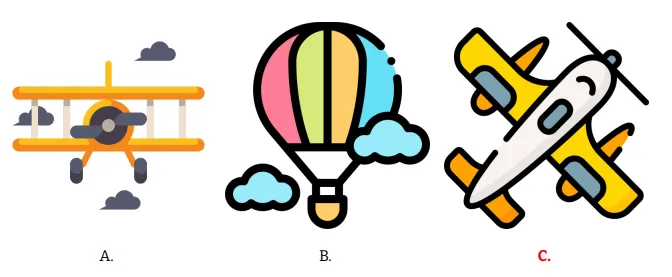
When the author talks about Armstrong’s plane, he calls it a monoplane. The prefix “mono-” means one, only, or single. So what do you imagine a monoplane to be?
Chapter 3
Another page from Armstrong's notebook went like this:
And then there was Myrtle's head. Do you really believe—does anybody really believe—that a man's head could be forced into his body by the force of a fall? Well, perhaps it may be possible, but I don't think that's what happened with Myrtle.
There was also the grease. There was grease on his clothes. And nobody questioned it! But I did. I have been thinking about it for a long time. And now, with a new engine in a lighter airplane, I should easily climb to 30,000 feet tomorrow. I'll have a shot at the record. And I will have my gun with me, so maybe I will have a shot at something else, too.
Of course, it's dangerous. If a person wants to avoid danger, then they should not fly at all. But I'll visit the air-jungle tomorrow. And if there's anything there, I'll know. If I return, I will be a celebrity. If I don't return, then this notebook may explain what I am trying to do and how I lost my life. (Just don't go on and on about accidents or mysteries, if you please.)
I chose my monoplane for the job. There's nothing like a monoplane when real work is to be done. For one thing, it doesn't mind the damp, and the weather looks as if we should be in the clouds all the time. This plane is easy to control. It also has all the modern improvements: enclosed fuselage, brakes, gyroscopes, and three speeds.
I took my gun with me, too. And I dressed like an Arctic explorer with two shirts, thick socks, a storm cap with flaps, and goggles. It was hot on the ground, but I was going to be higher than the mountaintops and had to dress for the part. My mechanic felt something unusual was happening. He wanted to go with me. That would have been all right if I had been using a biplane, but a monoplane is a one-man show. Of course, I took an oxygen bag. The pilot who goes for the altitude record without one will either be frozen or smothered—or both.
I had a good look at the plane before I got in. Everything was in order so far as I could see. Then I switched on my engine and found that she was running sweetly. When they let her go, she rose almost at once upon the lowest speed. I circled my home field once or twice just to warm her up. Then I waved to the mechanic and set out, climbing steadily. It's important to rise slowly and adapt yourself to the pressure as you go.
It was a warm day in September. There were clouds. There were some gusts of wind. Just as I reached the clouds at 3,000 feet, the rain started. It poured! I could barely see. As I got higher, it became hail. After the trouble passed, all I could hear was the engine purring as we went along.
About 9:30, I was above the clouds. The rain was below me. A few other flying machines were also dancing around at 1,000 feet. They were probably wondering what I was doing so high above. Suddenly a gray curtain of vapors swirled around my face. It was cold and miserable. But it wasn't the rain or the hail. It was something different. This cloud was dark and thick as London fog. I tried to move my plane higher, above this, but it was difficult. Soon, however, I was above the first layer with clouds below me and yet still above me like a floor and a ceiling of gray. It felt deadly lonely.
Chapter 4
Armstrong continued writing in his notebook:
Just after 10:00, I touched the bottom of the cloud ceiling. The wind had been increasing. Already it was very cold, though my altimeter only marked 9,000 feet. The engines were working beautifully, and we went droning steadily upwards. The clouds were thicker than I had expected, but at last it thinned out into a golden mist before me. Then, in an instant, I shot out from it, and there was an unclouded sky and a brilliant sun above my head—all blue and gold above, all shining silver below. It was 10:15, and I was almost at 13,000 feet.
Up I went. The wind grew stronger. My engine groaned. When I reached 19,000 feet, which was about midday, the wind was so severe that I looked at my wings with some anxiety. I expected to see them snap. I even prepared my parachute to be ready. I was feeling a little cold and sick, but I continued. At 1:30, I was nearly seven miles above the surface of the earth, and still ascending steadily. I found, however, that the air was giving much less support to my wings. I was climbing the sky slower and slower. To make matters worse, one of my spark plugs was in trouble again and there was sometimes a misfiring in the engine. My heart was heavy with the fear of failure.
It was about that time that I had a most extraordinary experience. Something whizzed past me in a trail of smoke and exploded with a loud, hissing1 sound, sending out a cloud of steam. For a moment, I could not imagine what had happened. Then I remembered that the earth is forever being showered by meteors, and that there wouldn't be life on earth unless these meteors turned to vapor in the outer layers of the atmosphere. This, I thought, was a new danger for the high-altitude pilot.
My instruments marked 41,300 feet when I became aware that I could go no farther. My machine had reached its limit. Soaring in circles like a hawk, I let the plane guide itself while I looked carefully around me. The stars above were clear, and there was no indication of those dangers which I had imagined.
Suddenly I was aware of something new. The air in front of me had lost its crystal clearness. It was full of long, ragged wisps of something like cigarette smoke. It hung about in wreaths and coils, turning and twisting slowly in the sunlight. As the monoplane shot through it, I tasted oil on my lips, and there was grease on the plane. Some organic matter appeared to be suspended in the atmosphere. There was no life there. But might it not be the remains of life? I thought I was going crazy when I looked up to see a wonderful vision. I'm not sure I can even explain it.
Imagine a jellyfish, but larger than the dome of the largest church. It was light pink and green. It pulsated with a regular rhythm. It had two long, green tentacles2 which swayed to and fro. The vision passed quietly over my head, like a soap bubble, and drifted on its way.
1 hissing (adjective) a long noise like the letter "s"
2 tentacle (noun) a long, arm-like parts of some creatures
|

Bình luận