IV. CONTINUOUS TENSE: EXPANSION AND EXERCISES
1. Introduction
1.1 How do We Use the Continuous Tense?
In the continuous tense, time is important. We use it for a limited action at a limited time. It is used only for this action at this time.
Example: Today, I am studying all day for my final exam. (that is filling my time for today)
The Continuous Tense is not usually used for multiple actions, although we can use it to list all of the things that are filling a specific time that we are talking about.
Example: This morning was very busy, I was cleaning my apartment, answering the phone, and watching my young child. (this could be happening all at the same time)
If the Simple Tense is about an action walking freely around in a big area of time, the Continuous Tense is about an action being held in a jail of time. There is always a time jail- time is mentioned, except in the present, where it is assumed that the action is happening now.
In addition, just like in real life, the time spent in jail can be measured. It could be very short, a point in time, or it could be longer, even a year or a decade.
With the continuous tense, two types of time restrictions are possible:
-
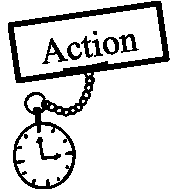 The action is quite short, and the time that is mentioned is very exact and it is centered around only a point in time. For example: at 4:00 a.m. I was eating breakfast.
-
 For a longer period of time, the action is also 'sentenced' to the jail cell for a period of time. A person in jail could have a sentence of one day in jail, or it could be years. In the same way, the action of the Continuous Tense has a period of time (a 'jail sentence') attached to it. Example: I was studying for the test all day yesterday.
Remember also that the action is continuous for the stated time period. It doesn't start and stop—there are no 'vacations'. Of course, just like being in prison, you might be let out into the exercise yard for a short time. However, you spend most of your time in the jail cell. In the same way, there might be a very short break in the continuous action, but it doesn't completely stop and then start again. There is progress in the action.
Example: Verb Tense in Context: My Busy Schedule
Last month was a very busy month for our business. It seems like people were calling all day every day. We were always trying to catch up on our work. Then, it seems like a disaster was always happening. Every day, something was going wrong. It seemed like people were getting sick, left and right. We were always filling in for someone who was sick.
This coming week will be very busy. On Monday, I will be going to class all day. On Tuesday, I will be working at my job and then coming home and cleaning my apartment. On Thursday, I have a research paper due, so I will be working on that for most of Wednesday. On Friday, I am helping my friend move to a new apartment. Luckily, I don't have anything that I must do on Saturday, so I will probably be just taking it easy and maybe watching TV. I don't know what I will be doing on Sunday, but I'm sure that something will come up.
I have a busy day today. At 8 o'clock, I will be checking my email. Then from 9:30 to 10:30 a.m., I will be meeting with my boss. Then, for the rest of the morning, I will be working on a project for a customer. In the afternoon, I am usually taking a lot of phone calls and trying to keep up with my recordkeeping. I am working late tonight, but I am leaving for home at 7:30 p.m. (using the present continuous to talk about the future). It will be an exhausting [participle—not a verb] day, so I hope that I don't fall asleep while I'm driving home from work.
|

Bình luận