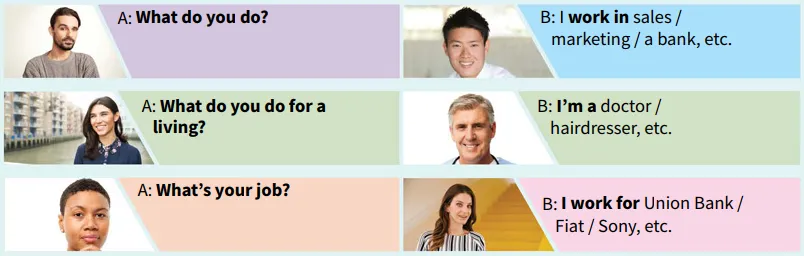
A. What do you do?
People can ask what job you do in different ways; you can answer in different ways.
B. What does that involve?*
James and Emma are business consultants [people who help others in a particular area]. They advise
people who want to set up [start] a business, especially in health and fitness. James deals with the
marketing [does the work in marketing; syn handle], while Emma is responsible for [in control of; syn in
charge of] products [things that people make/produce] such as towels, equipment, beauty products, etc.
Common mistakes
I have a lot of work to do. (NOT I have a lot of works to do.)
She advises me. (NOT She advices me.) BUT She gives me advice. (NOT She gives me advise.)
My job involves a lot of travel. OR My job involves travelling. (NOT My job involves to travel.)
Amy is a manager in a veterinary surgery. She runs [organises or controls] the day-to-day [happening
every day] business of the surgery and is in charge of a small team: three receptionists, an accounts
manager and a secretary. Her work involves a lot of admin [short for administration] such as buying
food, medicine and equipment; she also handles any complaints that customers make. [when
customers complain / say that something is wrong or is not satisfactory]
* What do you have to do exactly?
C. Pay
Most workers are paid [receive money] every month; this is called a salary. Your income is the total
amount of money you receive in a year. This might be money from one job; it might be money from
two jobs. We can express this in different ways:
My income is about £25,000. OR I earn/make about £25,000 a year [every year].
Some of that income you can keep, but some goes to the government; in the UK this is called income
tax, e.g. I lose 20% of my income in income tax.
Language help
A salary is money paid to professional people, e.g. doctors or teachers, and to office workers for the
work they do, and is usually paid into a person’s bank account every month. Wages are usually paid
for each hour/day/week of work to people who do more physical jobs, e.g. building or cleaning.
D. Conditions*
Most people work fixed hours [always the same], e.g. 9 am to 5.30 pm. We often call this a nine-to-five
job. Other people have to do/work overtime [work extra hours]. Some people get paid for overtime;
others don’t. Some people have good working conditions, e.g. nice offices, paid holidays, extra time
off [not at work] for a new mother and father when a baby is born, etc. There is also a minimum wage
[an amount of money workers receive, and employers cannot pay less than this].
* the situation in which people work or live
|

Bình luận