A. Asking someone for their opinion
What do you think of his new book / Tom’s girlfriend? (asking about a specific thing or person)
What do you think about global warming / cosmetic surgery? (asking about a general topic)
How do you feel about working with the others?
B. Introducing your own opinion
Personally, I think Helena was probably right.
Personally, I feel that we should increase the price.
In my opinion [I think], we need to change the direction of the company.
My view/feeling is [my opinion is] that we need to wait a bit longer.
Common mistakes
- Personally, I don’t think it’s a good idea. (NOT I
think it’s not a good idea.)
- In my opinion, motorbikes are dangerous. (NOT On my opinion OR In my
meaning)
- In most situations, it is probably easier and more natural to use personally.
C. Giving the opinion of others
The newspaper says that his death was not an accident. (NOT It’s written in the newspaper)
According to the paper [the paper says], the government didn’t know about it.
D. Agreeing and disagreeing (with someone)
- I totally agree (with you) [agree completely, 100%].
- I partly agree (with you) [agree but not completely].
- I agree (with you) to a certain extent [partly agree].
Common mistakes
I agree with you. (NOT I’m agree with you.)
Do you agree? (NOT Are you agree?)
- In British English, it is common to agree with someone before giving a different opinion.
- That’s true, but I think …
- I see what you mean, [I understand what you are saying] but …
- I agree to some extent, but …
- I think that’s a good point [idea or opinion], but …
- I take your point [I understand and partly agree with your opinion], but ...
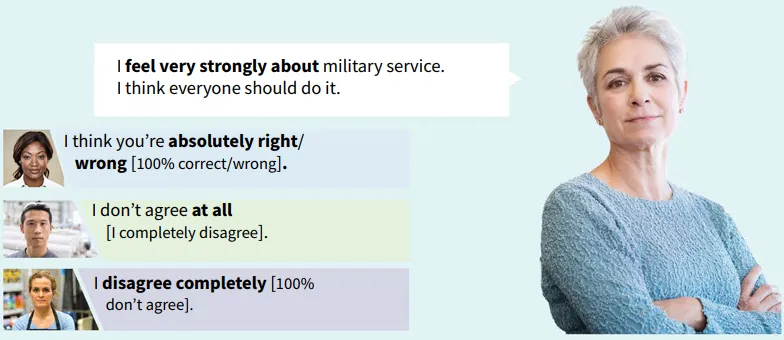
E. Giving a strong opinion
|

Bình luận