A. Weather conditions
Notice that it is very common to form adjectives by adding -y.
Dưới đây là bảng HTML gồm **2 cột**: *noun* và *adjective*, đúng theo nội dung bạn cung cấp:
There are common word partners to describe weather conditions:
It was very cloudy this morning, but the sun came out after lunch. [appeared]
The accident happened in thick fog [bad fog].
We had some heavy rain at the weekend. [a lot of rain; opp light rain]
There was a strong wind when we were on the boat. [a lot of wind]
The wind has blown all the apples off the tree.
It rained in the morning, but the sky was clear by lunchtime. [no clouds]
It’s been extremely cold today. [very; also extremely hot/windy]
B. Rain and storms
For heavy rain we often use the verb pour, e.g. pour with rain. For short periods of light or
heavy rain, we use the noun shower. A storm is heavy rain with strong winds.
 It poured with rain this afternoon.
Look, it’s really pouring (with rain) now.
We had a couple of heavy/light showers this morning.
A period of hot weather sometimes ends with a thunderstorm.
First it becomes very humid [the air feels very warm and wet],
then you hear thunder and see lightning, and it’s followed by heavy rain.
C. Temperature*
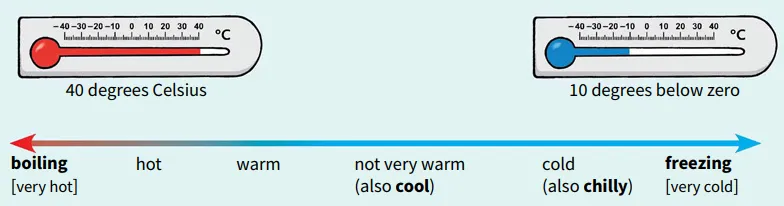
* how hot or cold it is
Language help
Cool can either mean slightly cold in a negative way, e.g. We’ve had a cool summer; or slightly cold in
a pleasant way, e.g. The water in the pool was lovely and cool.
Mild is often used in a positive way to describe weather that is not as cold as usual, e.g. It’s been a
mild winter.
|

Bình luận