Common suffixes that form adjectives include: -able (comfortable), -al (musical), -y (cloudy), -ous (famous) and -ive (attractive).
A. -al
Adjectives ending -al are usually formed from nouns, and often mean ‘relating to the noun’,
e.g. a musical instrument (from music), a political issue (from politics), an electrical fault
(related to electricity), a personal opinion (the opinion of one person).
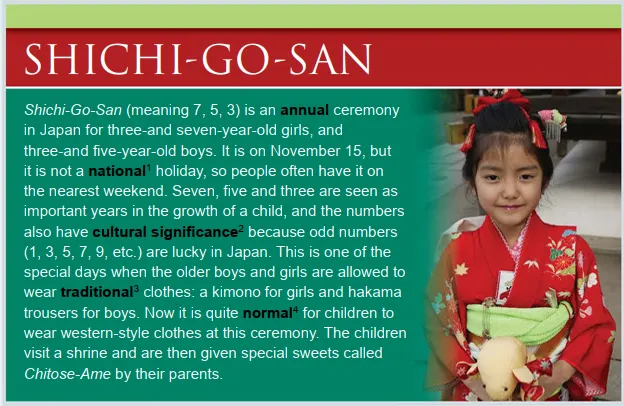
1 a holiday for the whole country
2 they are important in Japanese culture
3 in a style that has continued for many years
4 usual
B. -able /əbl/
This suffix forms adjectives from nouns and verbs, and the prefix un- often forms the opposite:
an enjoyable party [something that you enjoyed]
- a comfortable chair (opp uncomfortable)
- a suitable word or phrase [right/correct for a particular situation; opp unsuitable]
- a reliable service; reliable information [able to be trusted or believed; opp unreliable]
- fashionable clothes [popular now with many people; opp unfashionable]
- a reasonable decision or price [fair; not a bad decision or price; opp unreasonable]
- a sociable person [enjoys being with people; opp unsociable]
Sometimes the opposite form is the more common adjective:
- an unforgettable experience [something that cannot be forgotten]
- an unbelievable story [something that is very surprising and very difficult to believe]
C. -ful and -less
The suffix -ful often means ‘full of’ or ‘having the quality of the noun’, e.g. a colourful room has a lot of colour in it; a helpful person gives a lot of help; a peaceful place is calm and quiet.
The opposite meaning is sometimes formed by adding the suffix -less to the noun.
- a useful machine [having a lot of uses; opp a useless machine]
- a painful injection [giving pain and being unpleasant; opp a painless injection]
- a careful driver [drives with care and attention; opp a careless driver]
Common mistakes
The suffix is -ful (NOT full), so useful and careful (NOT usefull or carefull).
|

Bình luận