A. Phrasal verbs with no object
Some phrasal verbs don’t have an object. We cannot put other words between the parts
of the verb.
- When does your train get in [arrive]?
- Hold on [wait a moment], I just need to get my coat.
- The car broke down on my way to work. [stopped working]
- I’ll call for them at 8 o’clock. [go to collect them]
- We set off [started the journey] about 7.30.
B. Phrasal verbs with an object
Many phrasal verbs need an object. We can usually put the object in different positions.
- Put on your shoes.
- Put your shoes on.
- Turn on the TV.
- Turn the TV on.
- Take off your coat.
- Take your coat off.
These are separable phrasal verbs, but if the
object is a long phrase, it usually goes at the end,
e.g. I turned off the lights in the living room. If the
object is a pronoun, it must go
in the middle, e.g. Turn it off.
There are some phrasal verbs where the object must come after the phrasal verb.
- I will look after the children for you. [take care of them]
- How did the two men break into the shop? [enter the shop using force, e.g. breaking a window]
Common mistakes
Put them on. (NOT Put on them.); Take it
off. (NOT Take off it.)
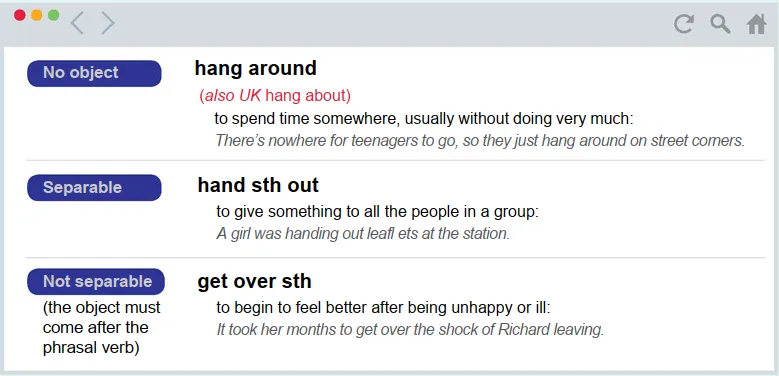
C. In dictionaries
Dictionaries usually show the grammar of a phrasal verb like this:
D. Style
Phrasal verbs are commonly used in spoken and written English. Many phrasal verbs are quite
informal, and sometimes there is a single word with the same meaning as a phrasal verb, which
sounds more formal. We use this word instead of the phrasal verb in more formal situations.
- leave sb/sth out [not include sb/sth; syn omit], e.g. He made a list of people but left me out.
- make sth up [create sth from your imagination; syn invent], e.g. We had to make up a story.
- put sth off [put sth back to a later date; syn postpone], e.g. They put the game off till Friday.
- turn sth/sb down [refuse an off er or request; syn reject], e.g. I off ered her a job but she turned it down.
|

Bình luận