Laura Dekker: Record-Setter!
Check Your Understanding
A Choose the correct answers for the following questions.
1. Which is NOT a reason people were against Laura's trip?
2. What do you think the line in paragraph 2, "She was born on a boat in New Zealand, and has hardly stepped off one since" means?
3. What is the main idea of the last paragraph?
B Read the following sentences. Check (✓) true (T) or false (F).
4. Laura got the idea to sail around the world when she was 15.
5. Laura sailed nonstop for 500 days.
6. Laura had to study while she was sailing.
7. People could follow what Laura was doing during her trip by reading her blog.
8. Laura is listed in the Guinness Book of Records for her achievement.
Critical Thinking
C Discuss the following questions with a partner.
- How would you describe Laura? What kind of person do you think she is?
- Do you agree with the Dutch government that Laura was too young to do the trip? Why, or why not?
Sample Answers
1. Laura seems very determined, brave, and independent. She had a strong passion for sailing and was willing to face many challenges to achieve her goal.
2. I partly agree with the government because sailing alone around the world is very dangerous, even for adults. But I also admire her courage and preparation.
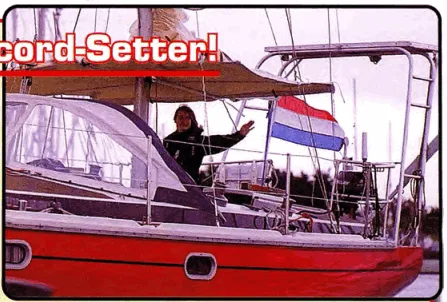
Laura Dekker: Record-Setter!
All athletes aspire to be the
best in their sport, and young
athletes are no different. More
young athletes now aim to win
5 competitions, set records, or
perform amazing feats. And
some, like Dutch sailor Laura
Dekker, achieve that goal.
As a child, Laura Dekker loved the sea. She was born on a boat in New Zealand, and has hardly stepped off one since. Laura first sailed by herself at age six, displaying a talent for understanding her boat and the confidence to control it. At 13 years old, Laura felt ready for the biggest challenge of all: she wanted to set the record for the youngest person ever to sail around the world alone.
Before she could do that, she had to face many challenges. While her parents were confident that she could do it, the Dutch government tried to stop her, arguing that she was too young to risk her life. Many people also felt that she should be focusing on her studies. After a long battle, she finally got permission. She had to go for classes to learn how to care for herself while alone at sea, and had to use a bigger boat than she was used to. To avoid falling behind in her studies, she had to sign up with a special distance-learning school and promise to do her homework at sea.
Finally, at the age of 15, Laura was ready. On January 20, 2011, she set out from the island of St. Maarten in the Caribbean on her 38-foot (11.5-meter) sailboat, Guppy. Her trip lasted 500 days in total, partly because she had to stop at different ports to study and check her boat. During this time, she visited exotic islands like the Galapagos, Bora Bora, and Vanuatu, and also found time to go surfing, scuba diving, and cliff diving. She even discovered a new hobby: playing the flute! Laura was alone for most of her journey, but she kept a blog that was read by many people around the world.
Laura returned to St. Maarten at the age of 16 years and 123 days, and was greeted by her family, friends, and many fans. She had become the youngest sailor to circle the globe alone. However, Guinness World Records and the World Sailing Speed Record Council did not verify her claim, saying they no longer recognize records for youngest sailors because it could encourage other young people to do dangerous things. Despite this, Laura felt a sense of achievement. She said that spending so much time alone on her trip helped her to focus on the important things in her life. "I became good friends with my boat," Laura said. "I learned a lot about myself."
achievement /əˈtʃiːvmənt/ n.
- something important and difficult that is done (thành tích, thành tựu)
- The Nobel Peace Prize is given to people who make great achievements. (Giải Nobel Hòa bình được trao cho những người có thành tựu lớn.)
aspire /əˈspɪə/ v.
- to desire and work toward achieving something (khao khát, mong muốn đạt được)
- He has aspired to be in the Olympics since he was a young boy. (Anh ấy đã khao khát được tham gia Thế vận hội từ khi còn nhỏ.)
exotic /ɪɡˈzɒtɪk/ adj.
- unusual or interesting, usually foreign (kỳ lạ, độc đáo - thường là từ nước ngoài)
- The model has an exotic look. (Người mẫu có vẻ ngoài kỳ lạ.)
feat /fiːt/ n.
- an impressive achievement (kỳ công, chiến công)
- The circus acrobats performed a dangerous feat, walking across a rope high in the air. (Những diễn viên nhào lộn xiếc đã thực hiện một kỳ công nguy hiểm, đi trên dây cao trên không.)
goal /ɡəʊl/ n.
- something you want to do in the future (mục tiêu)
- The goal of this meeting is to make a decision. (Mục tiêu của cuộc họp này là đưa ra quyết định.)
record /ˈrekərd/ n.
- the best time, distance, etc., in an athletic event (kỷ lục)
- She holds the world record for the 100-meter dash. (Cô ấy nắm giữ kỷ lục thế giới cho cự ly 100 mét.)
talent /ˈtælənt/ n.
- being able to do something very well without practice (tài năng, năng khiếu)
- Wayne has a great talent for riding horses. (Wayne có năng khiếu tuyệt vời với việc cưỡi ngựa.)
verify /ˈveri/ v.
- to say that something is true (xác minh, xác nhận)
- The newspaper verified that the factory was closing. (Tờ báo đã xác nhận rằng nhà máy sẽ đóng cửa.)
|

Bình luận