Vocabulary Learning Tips
Learning new vocabulary is an important part of learning to be a good reader. Remember that the letter C in
ACTIVE Skills for Reading reminds us to cultivate vocabulary.
1. Decide if the word is worth learning now
As you read you will find many words you do not know. You will slow your reading fluency if you stop at
every new word. For example, you should stop to find out the meaning of a new word if:
- a. you read the same word many times.
- b. the word appears in the heading of a passage, or in the topic sentence of a paragraph-the sentence that gives the main idea of the paragraph.
2. Record information about new words you decide to learn
Keep a vocabulary notebook in which you write words you want to remember. Complete the following
information for words that you think are important to learn:
3. Learn words from the same family
For many important words in English that you will want to learn, the word is part of a word family. As you learn
new words, learn words in the family from other parts of speech (nouns, verbs, adjectives, adverbs., etc.).
4. Learn words that go with the key word you are learning .
When we learn new words, it is important to learn what other words are frequently used with them. These
are called collocations. Here is an example from a student's notebook.
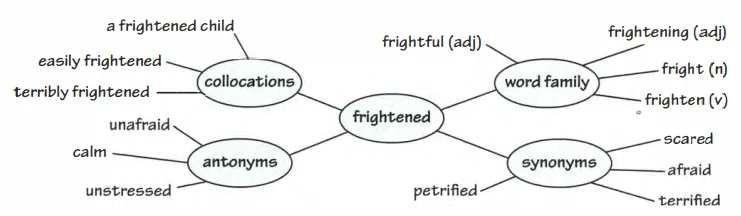
5. Create a word web
A word web is a picture that helps you connect words together and helps you increase your vocabulary.
Here is a word web for the word "frightened":
6. Memorize common prefixes, roots, and suffixes
Many English words can be divided into different parts. We call these parts prefixes, roots, and suffixes.
A prefix comes at the beginning of a word, a suffix comes at the end of a word, and the root is the main part
of the word. In your vocabulary notebook, make-a list of prefixes and suffixes as you come across them. There is a list of prefixes and suffixes in this book. For example, look at the word "unhappily."
7. Regularly review your vocabulary notebook
You should review the words in your vocabulary notebook very often. The more often you review your list of
new words, the sooner you will be able to recognize the words when you see them during reading. Set up a
schedule to go over the words you are learning.

8. Make vocabulary flash cards
Flash cards are easy to make, and you can carry them everywhere with you. You can use them to study
while you are waiting for the bus, walking to school or work, or eating a meal. You can use the flash cards
with your friends to quiz each other.
|

Bình luận